

Poverty’s meteoric rise
A lot can happen in an instant

This post was originally published on 13 June 2025.
What’s in a number?
Last week, the number of people living in poverty increased by over 100 million.
One moment there were an estimated 713 million people officially living in poverty; the next moment, 838 million were.
Not because of any meaningful change in people’s lives. This effectively was an increase on paper, sparked by a routine exercise at the World Bank to revise the international poverty line to account for changes in price indices and improved national poverty data. The Bank originally set the line for extreme poverty at $1.00 in 1990, then updated it to $1.25 in 2005, $1.90 in 2011, $2.15 in 2022, and now $3.00 in 2025.
The move may rekindle the long-running debate about how extreme poverty gets defined. Is someone living on $3.01 per day better off than someone living on $3.00 per day? Not really. But it’s useful to have definitions and data to measure progress on global poverty goals, and any number is susceptible to critique. Rather than getting mired in methodological debates, let’s look at what the numbers mean for people’s lives.
— Joe Kraus, Aftershocks Editor
3 things to know
1 in 10 people globally is considered extremely poor. Imagine attending a football or rugby match in a stadium that seats 50,000. Afterwards, 5,000 people are randomly selected and forced to live on less than $3.00 per day. That’s not too dissimilar to the randomised lottery that decides which of us are born into opportunity and which are not.
Why it matters: The World Bank acknowledges that the world is “very unlikely” to eradicate extreme poverty by 2030, the deadline for the Sustainable Development Goals. The Bank blames COVID-19, economic uncertainties, climate shocks, and fragility. Missing from its explanation: the role of politics and power. Such as asymmetrical trade, poor public financial management and corruption, bad policies, biased credit ratings, and donor governments backsliding on their funding commitments.Over 40% of the world’s people living in extreme poverty are in Africa. An estimated 559 million people in sub-Saharan Africa—nearly half of the region’s population—are living on less than $3.00 per day. That’s four times the global average.
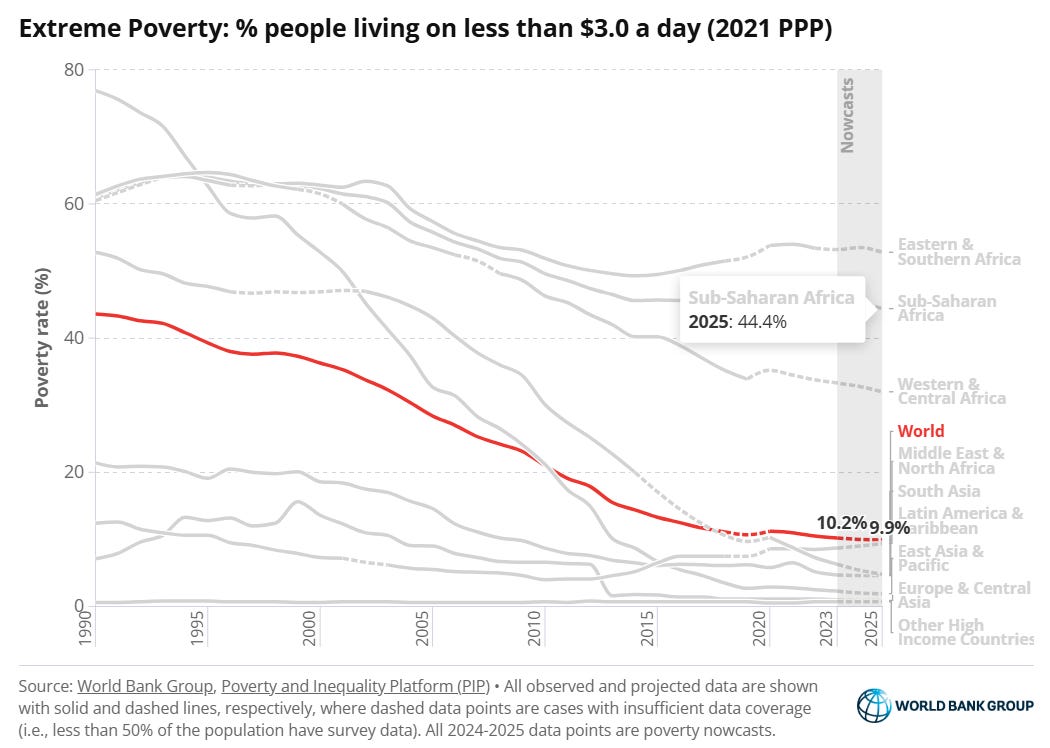
Why it matters: The $3.00 per day line is created using what’s called purchasing power parity. This means it is relative to the cost of purchasing a basket of core goods, benchmarked against 23 low-income countries. Imagine living on the equivalent of $3.00 per day (or $8.30 depending on where you live – more on that below), and you get a sense of just how debilitating—and devastating—that amount is.
Nearly half of the world lives on less than $8.30 per day. That’s the highest of the World Bank’s three poverty thresholds, which it applies to upper-middle-income countries (the threshold for lower-middle-income countries is $4.20). A shockingly high 88% of the people in sub-Saharan Africa live below $8.30 a day, the highest of any region.
Extreme Poverty: % people living on less than $8.30 a day (2021 PPP)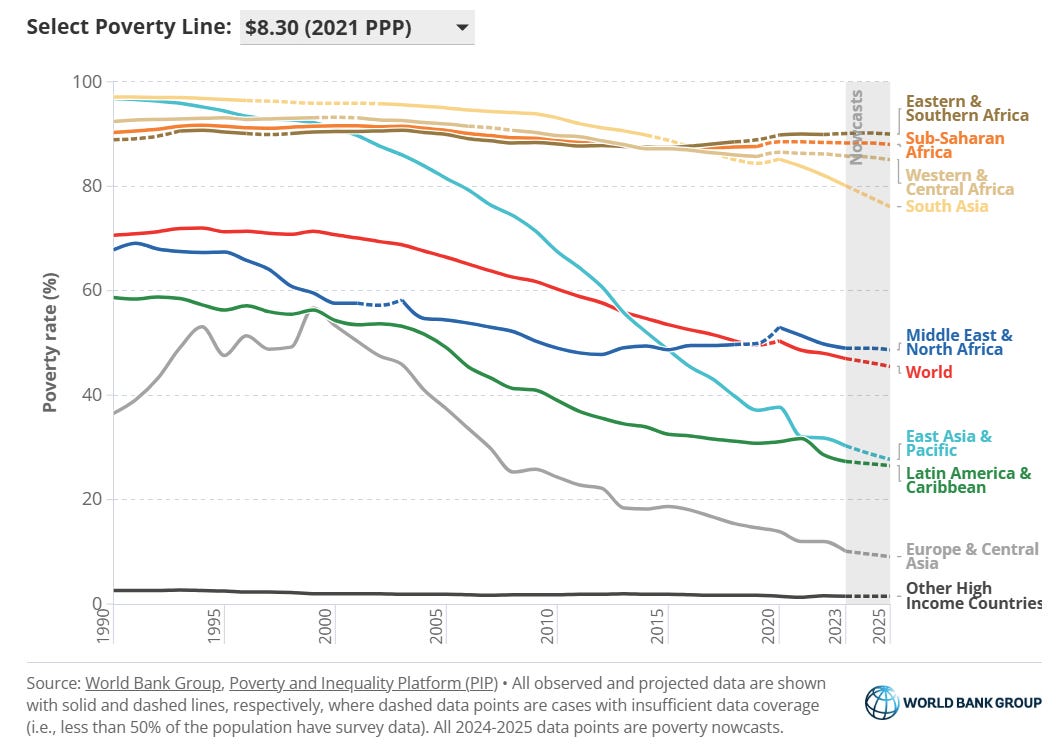
Why it matters: Living on $8.30 a day is hard. Thriving on $8.30 is really hard, especially if that money is helping to feed, clothe, and educate children. Yet that’s the struggle facing 3.7 billion people each day. That number has remained virtually unchanged since 1990. Though because of population growth, the percentage of people living in this level of poverty has declined from 71% to 47%. Progress, but there’s still a long way to go.


FROM THE ONE TEAM:
ONE’s analysis reveals that UK Prime Minister Keir Starmer is on course to be the biggest cutter of aid spending on record.
Our Canada team’s analysis on trade opportunities with Africa was spotlighted ahead of the G7 Summit.
IN THE QUEUE:
China announced it will remove tariffs for all 53 African countries with which it shares diplomatic relations (i.e. except Eswatini).
Leaders head to Canada this weekend for the G7 Summit hosted by friend of ONE and Canadian Prime Minister, Mark Carney. Look out for action on the high cost of debt for developing economies.
Africa must invest in itself.
The ONE Campaign’s data.one.org provides cutting edge data and analysis on the economic, political, and social changes impacting Africa. Check it out HERE.