

Losing the visa lottery
Not all passports are created equal

This post was originally published on 30 May 2025.
Travel discrimination
Let’s talk about travel discrimination. I hold a US passport, one of the world’s most powerful in terms of global access. I can travel to 182 destinations without obtaining a visa in advance (and over 100 without getting a visa at all).
Had I been born in Nigeria, like some of my colleagues, my passport would only open the doors to 45 destinations. That means that Africa’s most populous country has one of the world’s weakest passports.
A passport’s power has implications for our ability to travel to and experience other parts of the world. For far too many, that ability is hindered by expensive, onerous, and yes, sometimes discriminatory, visa processes.
— Joe Kraus, Aftershocks Editor
3 things to know
Countries with lower GDPs per capita have higher Schengen visa rejection rates. Rejection rates for visas to Schengen countries—29 European countries that have officially abolished border controls at their common borders—are strongly correlated with income. The poorer the country, the higher the chance of rejection. African countries are hit particularly hard, with rejection rates for Ghana, Nigeria, and Senegal above 45%.
2024 Schengen visa rejection rates by per capita GDP
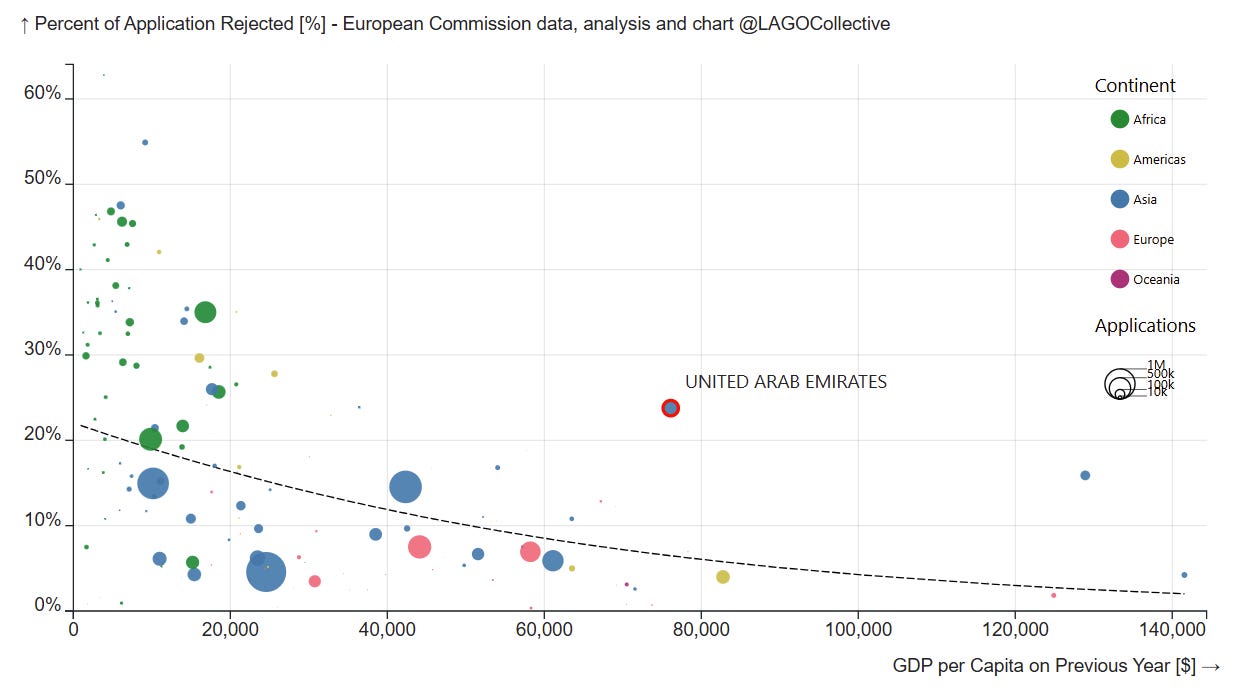
Why it matters: Behind these numbers are real people—blocked from opportunities, conferences, jobs, and partnerships—penalised for where they come from. Where you are born shouldn’t determine where you can visit.

Africa accounts for the most rejected Schengen visas. Over 700,000 African applications for a Schengen visa were denied in 2024, the most of any region. Africa had 41.3% of all rejected Schengen visas. Africa’s rejection rate (27.4%) was more than double Asia’s (11.1%) despite the latter accounting for over twice as many applications (5.9 million vs. 2.6 million).
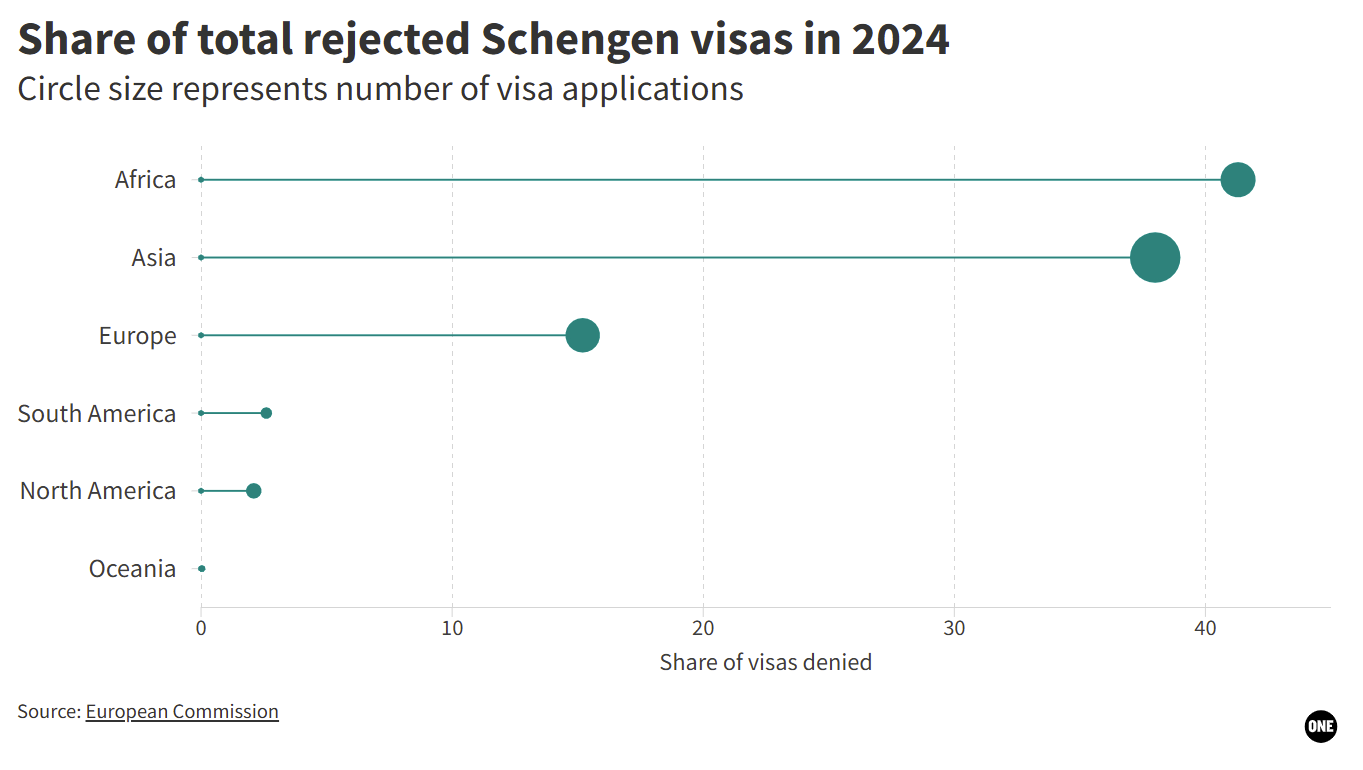
Why it matters: Africa’s 1.5 billion people are essentially being told to stay home, or spend a lot of time, money, and emotional energy trying to visit Europe. Visa applications can take months to secure, with people often not knowing until the day of their planned travel whether they’ll get a visa. That translates into uncertainty, stress, last minute canceled flights, and missed travel-–and the many personal and professional opportunities it affords.
Rejected visas carry a high price tag. New analysis from Lago Collective finds that the fees charged for rejected Schengen visas cost applicants $163 million in 2024, an increase of 11% from the prior year. Africans lost nearly $70 million.
Why it matters: The world’s poorest people are paying rich countries to *not* receive visas. Applying for a Schengen visa costs an applicant from the Central African Republic 20% of the country’s per capita income. An American spends just 0.12% of the US’s average income for the same application. And it’s a much riskier proposition for the CAR applicant, who has a 1 in 3 chance of being denied. Only 1 in 25 US applicants is denied a Schengen visa.

FROM THE ONE TEAM:
ONE Canada on why Canada should trade more with Africa.
ONE’s teams around the world were out in force on Africa Day.
David McNair on the role China is playing in Africa’s debt.
IN THE QUEUE:
Africans are losing millions in denied visas applications to Europe.
Big aid is over.
How to hide a superyacht in plain sight.
The ONE Campaign’s data.one.org provides cutting edge data and analysis on the economic, political, and social changes impacting Africa. Check it out HERE.
Really solid breakdown of how economic disparity gets encoded into mobility rights. The stat about CAR applicants risking 20% of per capita income versus 0.12% for Americans perfectly captures how visa systems amplify existing inequalities rather than level them. I've seen colleagues miss critical conference opportunities because of these arbitrary barriers, and it genuinely stifles global colalboration. The $163M in rejected visa fees is basically a regressive tax on the world's poorest trying to participate in th global economy.