

Coffee has a problem
More than one, actually

Originally published on 1 August 2025.
What’s in your cup?
Coffee is the third most consumed beverage globally, after water and tea.
Yet the millions of people that grow coffee see relatively little of the profits. It’s a story as old as time: The producers of raw materials least enjoy the fruits of their labour.
Africa is the birthplace of coffee (arabica coffee originated in Ethiopia and robusta coffee in central Africa). Today, however, Africa accounts for just 11% of the world’s coffee production. But that could change: Africa is a leading producer of robusta coffee, which will become increasingly important in a climate-changed world.
So grab a cuppa and learn more about the caffeinated bean that has fueled a $500 billion industry and helped conquer countless to-do lists.
— Joe Kraus, Aftershocks Editor
3 things to know
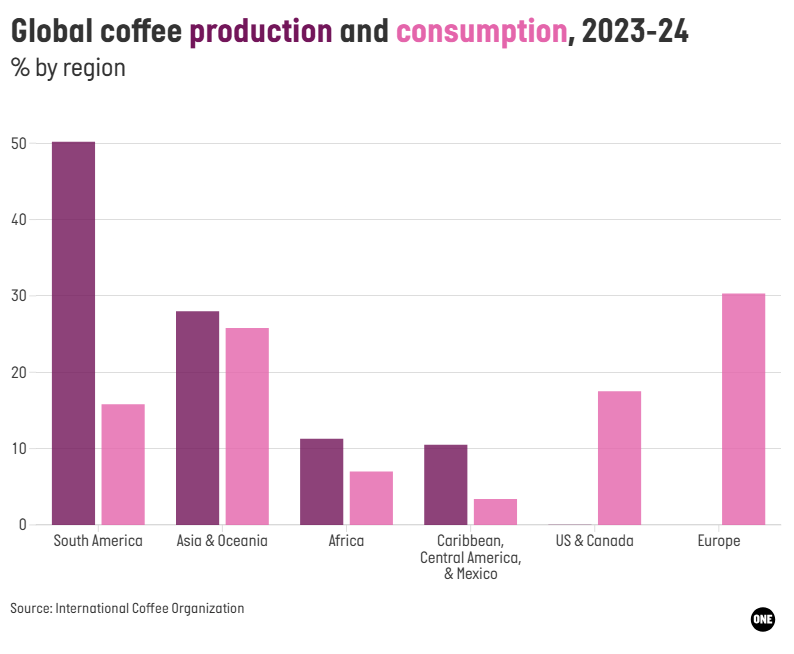
Over 2 billion cups of coffee are consumed each day. Much of that enjoyment takes place in the global north, despite nearly all coffee being grown in the global south. Canada, Europe, and the US produce negligible amounts of coffee compared to other regions yet account for nearly half of global coffee consumption (the US state of Hawaii and the Canary Islands—an autonomous community of Spain—grow small amounts). Ethiopia and Uganda—Africa’s leading coffee producers—grow the fifth and sixth most coffee in the world, behind Brazil, Vietnam, Colombia, and Indonesia.
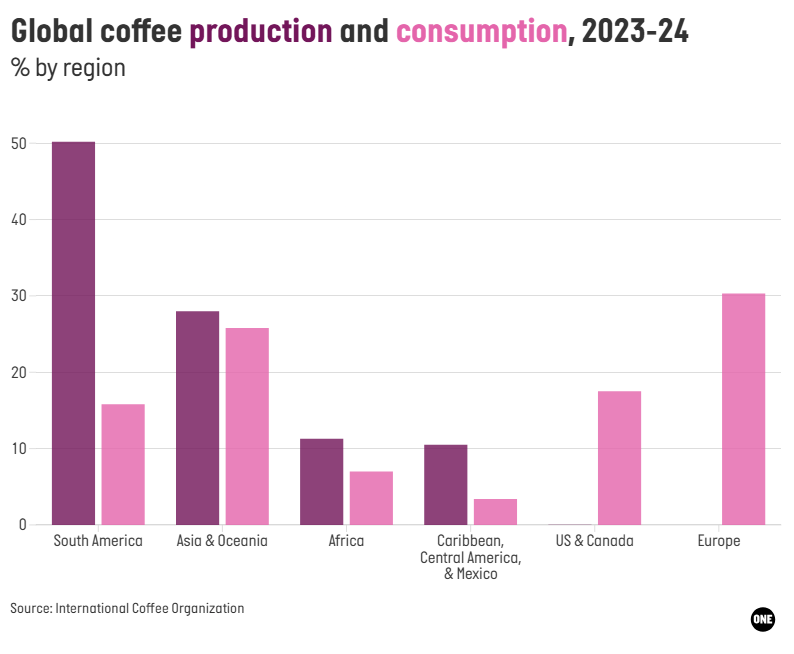
Click to view an interactive version of the chart.
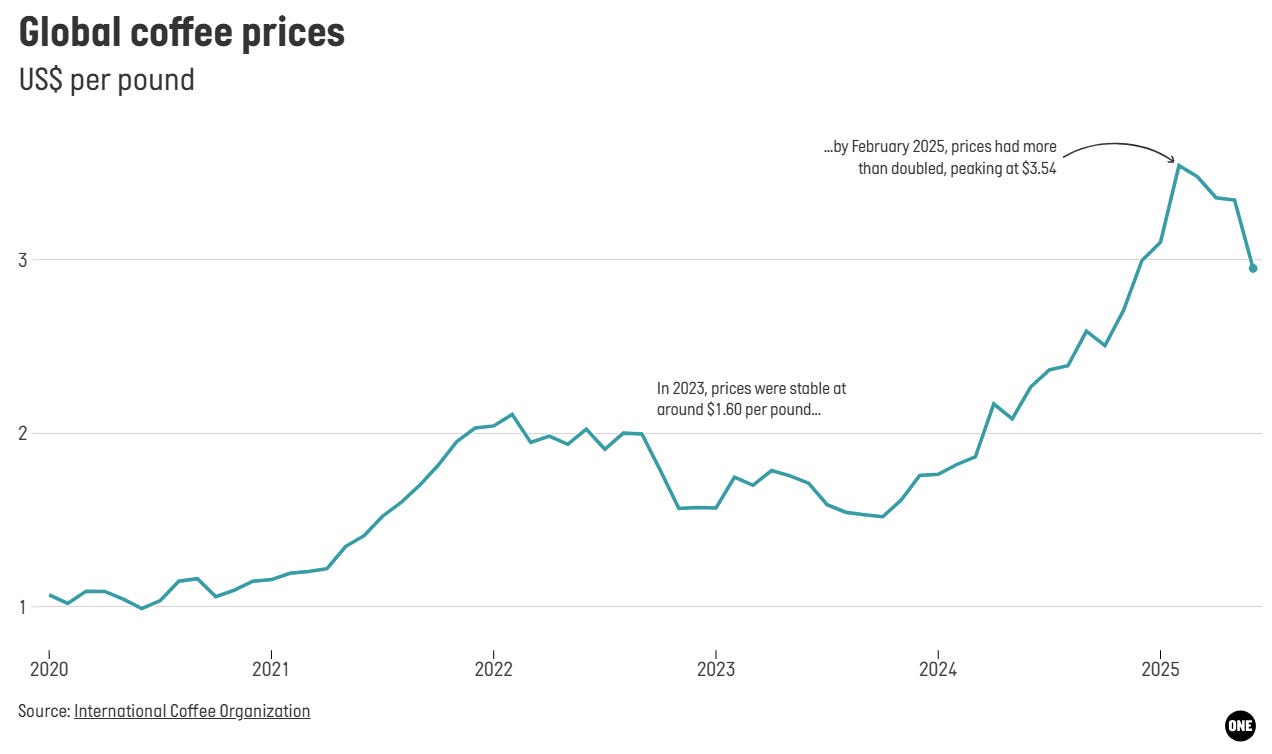
Why it matters: Many of the 125 million people whose livelihoods depend on coffee are smallholder farmers whose incomes don’t cover basic needs despite coffee’s popularity. They are at the whims of price volatility, market speculation, and a handful of multinational corporations that dominate coffee roasting and retail. That leaves farmers with little negotiating power.The price of coffee on global markets doubled over the past two years. Demand has been outpacing supply. Crop losses due to droughts, frosts, and unreliable rainfall hit major coffee producers like Brazil, Indonesia, and Vietnam. Rapid growth in demand from emerging markets—most notably China—has put pressure on already stretched supplies. And trade speculators (as they do) drove up prices beyond the fundamentals of supply and demand.
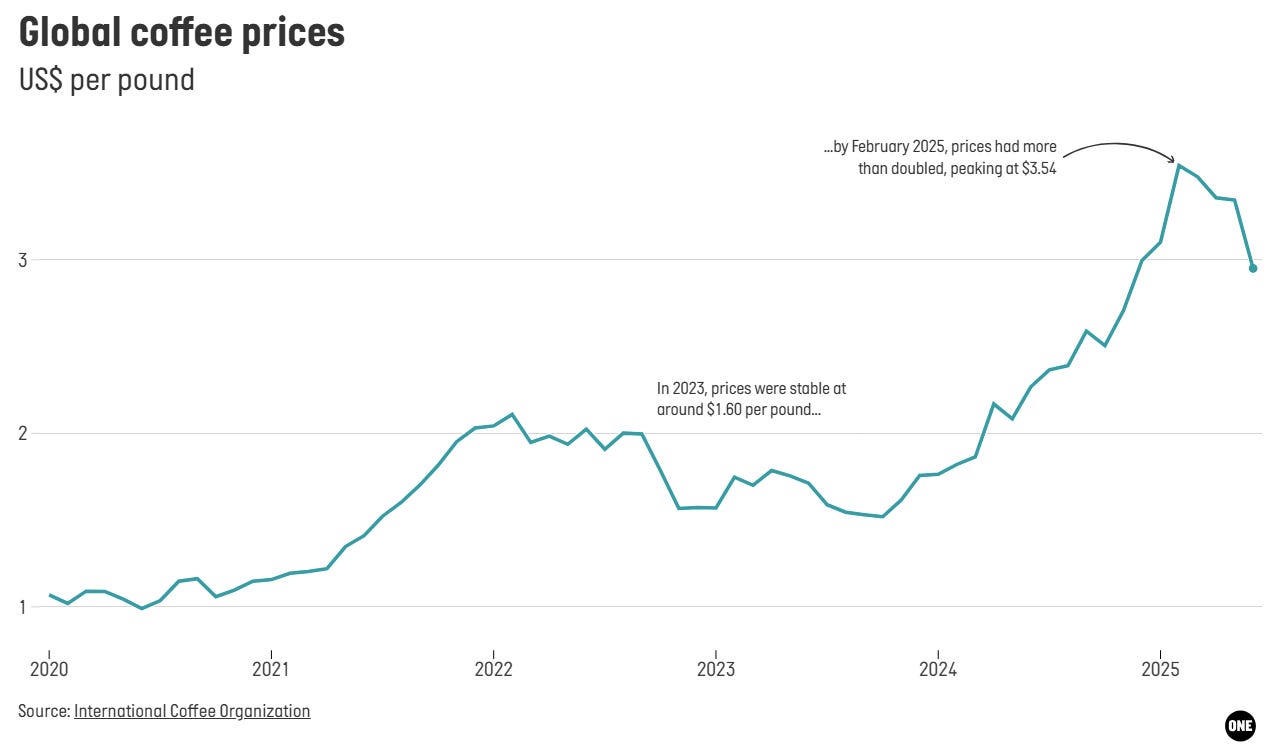
Click to view an interactive version of the chart.
Why it matters: Many of the 125 million people whose livelihoods depend on coffee are smallholder farmers whose incomes don’t cover basic needs despite coffee’s popularity. They are at the whims of price volatility, market speculation, and a handful of multinational corporations that dominate coffee roasting and retail. That leaves farmers with little negotiating power.
Climate change might kill your caffeine buzz. Coffee plants—like many of us—are sensitive creatures, with specific temperature, rainfall, and humidity needs. Climate change puts them at greater risk from pests and disease. That includes coffee’s current #1 nemesis, coffee leaf rust—a fungal disease that particularly attacks arabica coffee plants and has developed resistance to available remedies.
Why it matters: East Africa is expected to experience the most significant climate change-related reductions in coffee production, with declines of up to 90% by 2080. That will force production to relocate. It will also increase the importance of robusta coffee in the global supply chain. Robusta is hardier than arabica and tolerates higher temperatures. It now accounts for roughly 40% of global coffee production, up from 25% in the 1990s. Just six countries—Brazil, Côte d’Ivoire, India, Indonesia, Uganda, and Vietnam—produce 95% of the world’s robusta coffee. Uganda, the world’s 2nd largest producer, saw its robusta exports surge by 46% between May 2024 and May 2025.
FROM THE ONE TEAM:
Adrian Lovett sounds the alarm about steep UK aid cuts.
A study commissioned by ONE, Oxfam Novib, and Cordaid finds that €1 of Dutch development aid generates more than €2 in exports and supports nearly 11,000 jobs.
We pay tribute to David Nabarro—a leading light in the response to hunger and pandemics and a friend of ONE—who passed away unexpectedly last week.
IN THE QUEUE:
Uganda’s robusta coffee farmers have big ambitions.
The Pan-African parliament calls for urgent AI safeguards.
The ONE Campaign’s data.one.org provides cutting edge data and analysis on the economic, political, and social changes impacting Africa. Check it out HERE.